Tab 1
Tab 2
Tab 3
Out of Band Management
Network availability issue
The duration of cellular site outages has direct and negative impacts on subscribers’ businesses and activities. Managing the planning, routing, and allocation of resources, while coordinating field service requests is not without challenges, especially when handled manually. It is essential to overcome the following obstacles to maintain operational efficiency and provide exceptional customer satisfaction. Coordinating multiple service requests, technician availability, logistics, and customer demands is a complex and time-consuming task, especially when it involves urgent or high-priority tasks that can disrupt even the best schedules. Optimizing routes to minimize travel time while maximizing the number of tasks completed each day requires the kind of careful planning, best handled by software algorithms. It is also essential to assign the right technician with the appropriate skills to each service call to ensure quick and effective problem resolution.
Already known
Without a doubt, out-of-band (OOB) management (secondary access path) of a down cellular site and therefore inaccessible via the primary path, generally offers five (5) key advantages:
- Allows the technical team to immediately analyze from the control center the historical alarms and check the operational status of the electronic components of the equipment. It provides the advantage of quickly identifying the source of the failure and, if necessary, dispatching technicians to the site with the spare parts and instructions needed to resolve the problem.
- Maximize network uptime to maintain business continuity.
- Troubleshoot, restart, and reconfigure site equipment remotely, from anywhere.
- Recover quickly from disasters and power outages.
- Reduction of inherent costs in on-site technical staff and travel.
Our solution
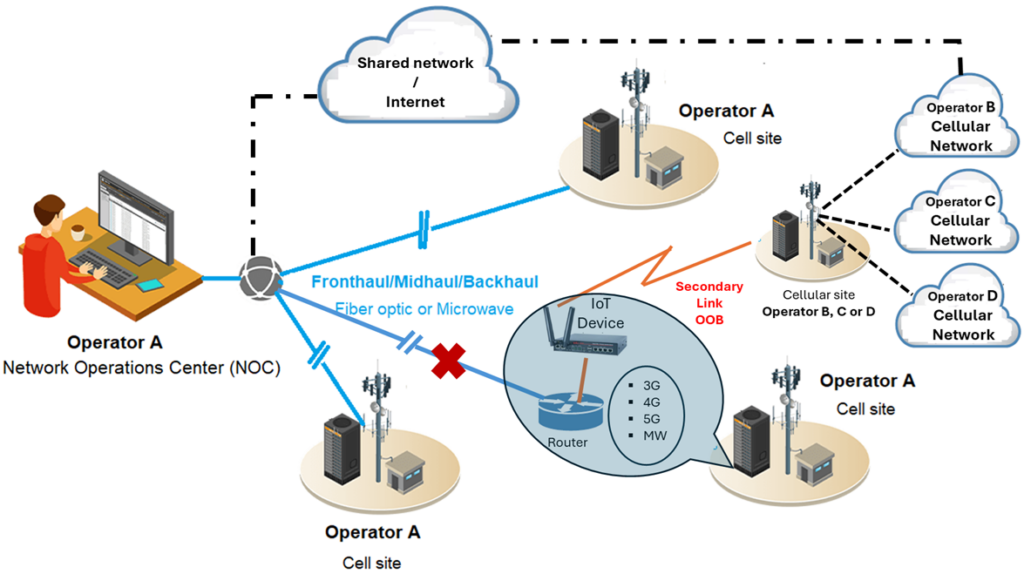
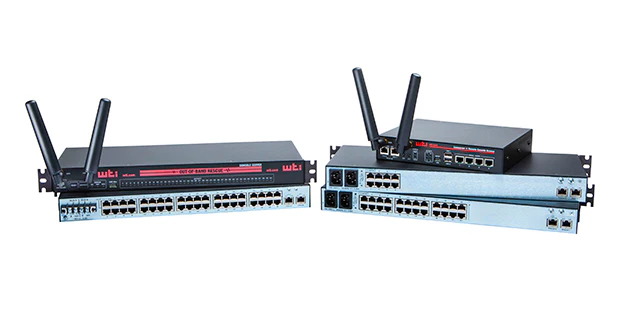
The out-of-band network management solution offered by Unified Cells is based on the combination of Virtual Mobile Network technology provided by our MVNE and a console server device. It consists of inserting a SIM card into a console and deploying it at a cellular site. As illustrated in the diagram, Operator A’s site with a console server is remotely accessible by the operations and monitoring center, through Operators B, C, or D, in the event of a primary link failure.
The particularity of this solution is that out-of-band managed sites via competing operators occurs seamlessly. The specialized SIM card automatically selects a competing base station which offers the best signal. Traffic through the competitor’s cellular network is encrypted, thereby ensuring confidentiality and integrity.
Advantages
In addition to the known benefits of an out-of-band network access, the proposed Unified Cells IoT solution offers the following advantages:
- Provides multiple cellular carriers on a single SIM with an automatic switchover.
- Securing communication through encryption using the IPSec technique.
- Only the consumed data quantity is billed.
- Allocated data plans through the virtual mobile network are done per site or per pool of sites basis.
- Operators can monitor their data consumption through the virtual mobile network management platform.